How to Write Tweets in 2026 Without Sounding Like AI
You write better tweets by putting one true idea in a first line that can stand alone, then stopping. The 2026 Google results for "how to write tweets" still teach 140 characters, hashtag dumps, and quote cards. Those pages answer a 2012 product. They do not answer For You, AI tells, or a founder who has 20 minutes.
This page is a myth-busting lab built from 16 Reddit threads, two Quora and People Also Ask clusters, and the live SERP collected 27 Aug 2026. You will get a coded pain table, five myths with verdicts, and a first-line scorecard you can run on any draft. If you want a reviewed queue instead of a blank composer, Xfaste.st drafts in your voice, caps originals at four per local day, and lets you edit or cancel until the slot hits.

Methodology: Based on analysis of 16 Reddit threads from 2023 to 2026 in r/SaaS, r/indiehackers, r/socialmedia, r/Twitter, r/marketing, r/gamedev, r/writing, and r/NavalRavikant, plus Quora and People Also Ask questions on tweet examples, the 4-1-1 rule, and the 80/20 rule. Insights paraphrased and cited with subreddit and upvotes only. Added transformation: coded theme table, five-myth lab, and a first-line scorecard tied to For You weights.
Why do most how-to-write-tweets guides still talk about 140 characters?
Because they were written for a different app and never got rewritten. The live SERP on 27 Aug 2026 led with X's own "how to post" help page, then a marketing blog that still says "limit yourself to one idea," then a checklist that opens with "Twitter's 140 character limit." WikiHow still ranks for examples. A 2015 "how to tweet" video sits in the video block.
That is a gap, not a coincidence. People search "how to write tweets" when they are stuck at the composer. Google still serves UI tutorials and pre-rebrand copy. The poorly answered cluster is the craft question: how do you write a post a stranger will finish, without sounding like a prompt.
X posts are 280 characters on a free account. Premium can go longer. For You still shows a short card. If the first line is filler, the rest never loads. Character math is not the job. The job is one idea, one predicted action, one voice.
What 16 Reddit threads actually argue
We coded each thread by the job the poster was trying to do, not by the keyword they used. Exclusive buckets, so the shares add to 100.
| Theme we coded | Share of 16 | Typical stance, paraphrased | Our added note |
|---|---|---|---|
| AI drafts sound like a poster | 25 percent | Consistency made them sound generated | Volume is not voice. Edit until a friend could pick you out of a lineup |
| Unattended agents are a dare | 19 percent | "I gave an agent my account, it writes five a day" | r/indiehackers ran this as a live experiment (21 upvotes, 166 comments). Comments beat the pitch. Review is the product |
| Fake founder flexes | 19 percent | "$10k MRR tweets are a course funnel" | r/SaaS calls this out often. If the first line is a round number, assume a screenshot, not a method |
| Hooks that name the outcome | 12 percent | Lead with the job, not the stack | r/indiehackers advice on customer posts: the dashboard line beats the tech line |
| Engagement pods and paid RTs | 12 percent | If nobody sees you, buy a boost or join a group | Cheap likes can still train mutes. For You prices a mute at -58.8 against a like at 0.5 |
| Tags, screenshots, and silence | 13 percent | Years of GIFs, 5 to 10 reactions | Format is not a substitute for a sentence someone can answer |
The r/socialmedia consistency thread is the poorly answered cluster. People report that trying to "post every day" turned their account into a walking motivational poster. One reply said auto-generated tweets felt like that, and mixing in random day-to-day thoughts cut through better than a perfect tweet vibe (r/socialmedia, AI-sound thread).
Totally get what you mean.
(r/socialmedia, consistency thread)
That quote is the pain. It is not the diagnosis. Our counterpoint: For You does not score polish. It scores predicted replies, quotes, shares, and follows. A stiff "value bomb" can look finished and still earn a mute.
r/SaaS asked, plainly, whether anyone had used AI to create tweets. The useful answer was not a brand. It was "edit anyway, even if you use a popular writer, you cannot ship 100 percent model output if you want credibility" (r/SaaS, AI tweets thread). That is still the floor in 2026.
Quora and People Also Ask still orbit the 4-1-1 rule, the 80/20 rule, and "what is an example of a tweet." Treat those as question mines. They are not a scoring manual.
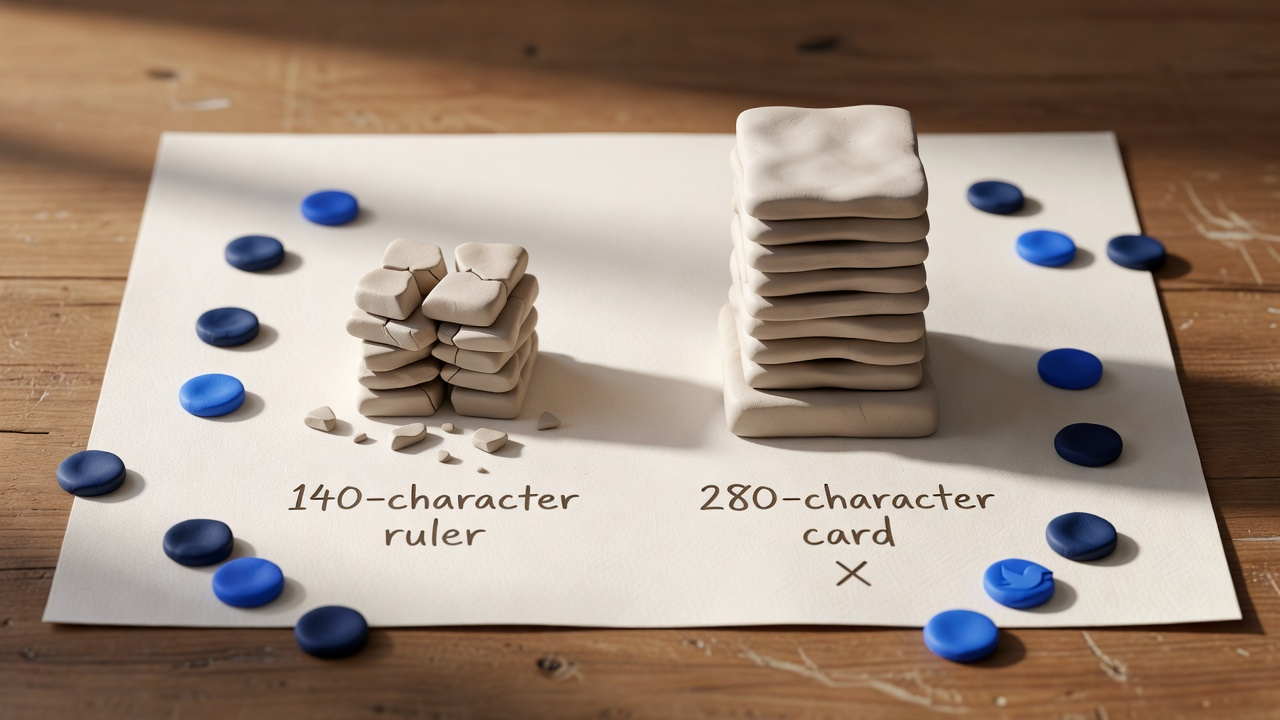
What myths about tweet writing should you drop in 2026?
Myth 1: Stay under 140 characters or you will not get retweeted
Where it still ranks: checklists that never updated after the 280-character change.
What evidence says: You have 280 characters. Threads exist when you actually have a sequence. Most founder posts do not need a sequence. They need one line that works as a card, then one or two sentences that earn a reply. Our thread guide is for the cases that do.
Verdict: False for 2026. Short is still good. 140 as a hard cap is nostalgia.
Myth 2: Hashtags and namedrops are how you get discovered
Where it still ranks: WikiHow-style lists (ask a question, drop a quote, tag people).
What evidence says: Hashtags are not an explicit For You head. Tagging 12 people who did not ask is a mute teacher. A specific question to a real niche is different from a mention spray.
Verdict: Mostly false. One relevant mention can be a conversation. A tag salad is leftover 2014 playbook.
Myth 3: The 4-1-1 and 80/20 rules will write the tweet for you
Where it still ranks: People Also Ask for this exact query.
What those rules meant: 4-1-1 was four pieces of others' content, one share of your own, one self promo. 80/20 was 80 percent useful, 20 percent promo.
What evidence says: Ratios do not choose a first line. Founders who only "add value" and never name the product still stall. Founders who only plug still get skipped. The useful split is idea first, product after the idea, not a fraction you police with a spreadsheet.
Verdict: Harmless as a reminder. Useless as a sentence.
Myth 4: If you post consistently, AI will make you sound like you
Where it still ranks: tool pitches, plus the r/indiehackers agent threads.
What evidence says: r/SaaS: edit. r/socialmedia: daily cadence without voice reads as generated. r/Twitter: people now talk about posts getting marked as made with AI. r/NavalRavikant even joked that old distilled tweets now look like model output (r/NavalRavikant, AI-sound thread). Distillation is not a crime. Unedited template rhythm is.
Verdict: False. AI can draft. You still pick the line you would say out loud.
Myth 5: A round-number screenshot is a writing template
Where it still ranks: r/SaaS "why do indie hackers on Twitter have $10k MRR" threads, plus 90-day miracle writeups.
What evidence says: A lot of those posts are selling a course, not documenting a craft. r/SaaS commenters say it out loud. Copying the flex does not copy the buyers.
Verdict: False. Steal the specificity, not the trophy.
How do you write a first line that can stand alone?
For You often shows one card. If the first line is "Thread:" or "Excited to share," you already lost the people who will never tap. Write the first line as if the rest will never load.
Run this scorecard on the line. Yes is 1. No is 0. Ship at 4 or higher. Rework below 3.
| Check | Why it matters | Fail example | Pass example |
|---|---|---|---|
| Names a concrete thing | Abstractions do not invite a reply | "Lessons from building in public" | "I deleted 40 tweets this month. 3 of them were the product pitch." |
| Could be a reply, quote, or follow | Those beat likes in the default For You sum | "Like if you agree" | "What do you cut first, the hook or the plug?" |
| Sounds like speech | Template cadence is the AI tell | "In today's fast-paced world, founders must..." | "I rewrote this four times. Version four was 12 words." |
| No trophy, no countdown | Round numbers read as ads | "We just hit 10k MRR in 90 days" | "Month 4, still 11 paying users, here is the post that got the 11th." |
| No hashtag pile | They eat the card and do not score | "New drop #saas #ai #buildinpublic" | One idea, zero tags |
| Stops after one idea | Second idea belongs in the next slot | Feature list in one breath | One constraint, then stop |
A like is cheap in the ranking sum (weight 0.5). A reply is 5. A quote is 5. A follow is 4. A mute is -58.8. That matrix is in our impressions piece. Writing implication: ask for a specific answer you would actually want in public. Do not bait a fight you cannot sit with.
r/indiehackers advice on early-customer posts is the same check in street clothes. Do not lead with the stack. Lead with the job: the line that says what the reader gets to decide. Then you can mention the product.

How do you use AI without sounding like AI?
Use it as a starter, not as the account. The r/SaaS edit rule still wins. The r/indiehackers "full access, five tweets a day" thread is a useful negative. People will argue with the agent. They will not trust the founder.
A practical pass:
- Start from a fact you observed this week. A support ticket, a failed demo, a sentence a user actually said. If you cannot point to the fact, do not generate yet.
- Ask the model for three first lines, not a finished post. Keep the one you would say on a call.
- Strip the tells. Parallel lists of three. "Here's the thing." "Let's dive in." "Game-changer." Empty intensifiers. A hyphen sandwich where a period would do. (Hyphens in URLs and compound modifiers are fine. The tell is the ornamental pause.)
- Read it out loud once. If you stumble, cut. If you would not text it to a cofounder, it is still a poster.
- Put the product after the idea. Open-link weight is low. Follow-author weight is not. A useful observation can earn the follow. A landing page in line one earns the skip.
X may label some generated media. Do not treat a label as the only risk. The bigger risk is a feed of posts that all share one rhythm. r/socialmedia already described that feeling. Your buyers feel it too.
Em dashes are a bad heuristic, by the way. A r/linux thread had to say it: people used them in human prose for a century. Cutting them because a detector panicked is cargo cult. Cut them here because our house style wants periods. That is taste, not forensics.
What is a simple founder checklist for writing tweets this week?
Use this as a writing loop, not a streak app.
- Collect four facts, not four hot takes. Tickets, quotes, constraints, numbers you can stand behind.
- Write four first lines on paper. Score them with the table. Keep the ones at 4 or higher.
- Add at most two sentences. One is often enough. If you need eight, you wanted a thread, or you wanted a blog post.
- Schedule at most four originals per local day. Author diversity decay punishes same-hour copies. The best time is when your buyers are on X, not a global heatmap.
- Reply with a fact, not "this." Replies do not retrieve you into For You. They can still start the follow that later does.
- Log one number besides likes. Replies, profile visits, or signups. If the graph is busy and the inbox is dead, you wrote for the wrong room.
- Do not join a pod to fix a weak line. r/marketing still lists pods and paid retweets as growth. They can move a counter. They rarely teach you how to write the next post.
Worked examples you can steal the shape of, not the facts:
Fail: "Thrilled to announce our AI-powered platform helps founders leverage Twitter for seamless growth."
Pass: "I spent 40 minutes on a tweet that said nothing. The one that got a customer email was 14 words and named the error message."
Fail: "Thread: 10 hooks that went viral this week (save this)."
Pass: "If the first line needs 'Thread:' the card already lost. Write the point. Stop."
Fail: "We hit 10k MRR. Here's the thread."
Pass: "11 customers, 4 of them came from replies under other people's posts, 0 from the launch screenshot."
None of those promise reach. They name a thing a peer can argue with. That is the whole craft.
Honest tradeoffs
A ghostwriter who knows your product will beat a model you never edit. A private journal will beat a public account you resent. If you want a scheduler for five networks, look at a generalist, including some Hypefury alternatives. If you want guaranteed virality, you want a screenshot vendor, not a writing method.
Xfaste.st is not the right tool if you want an unattended spam bot, or if you refuse to read a draft before it goes out. It is a workspace for people who will review. Studio is 280 characters. Voice profile, product facts, and a humanizer exist so the draft is less generic. Post Coach is a free editing prompt, not a verdict. Scheduled originals cap at four per local day. You can edit or cancel until the time hits.
As of Aug 2026, public pricing is $19 per month or $136.80 per year (40 percent off), with a paid from day one. New checkouts go through Whop. The 500-in-30-days line is a refund on a paid period if the connected account ran the daily method and still missed 500 net followers. It does not sell followers. Canceling is not that refund. Getting 500 verified followers is a different search. That one means Premium checkmarks. For the mechanical de-AI pass, use How to Clean Up AI Writing for Twitter.
Build a small reviewed queue in your own voice with Xfaste.st. Compare billing on the pricing page. More founder writing sits on the blog.
FAQ
How do you write tweets that people actually finish?
Put the whole point in the first line, then add one concrete detail. If the card needs a tap to make sense, rewrite the card. Ask for a reply you would want to read. Stop after one idea. Four reviewed posts beat a dump of ten almosts.
What is an example of a tweet that does not sound like AI?
A line you would text a cofounder, plus one fact. "I cut the feature list out of the tweet. The version that named the error message got the reply." Specific, past tense, no trophy, no hashtag. If a stranger could paste it on 200 accounts, it is still a template.
Does the 80/20 rule still apply to Twitter posts?
As a reminder not to only plug, yes. As a writing system, no. The 80/20 and 4-1-1 rules do not choose a first line. Write the useful observation. Name the product after it, not instead of it. Count conversations, not the fraction.
Can I use AI to write tweets?
Yes, as a starter. r/SaaS's useful answer was still "edit." Do not grant an agent full send access and call that a voice. Generate three first lines from a real fact, keep the one you would say out loud, then schedule it yourself.
How many tweets should I write per day?
Enough to have four strong originals in local-day slots, not enough to trip author diversity decay. If you only have one true idea, post one. Empty cadence is how accounts start sounding generated. Writing more drafts than you ship is fine. Shipping every draft is not.